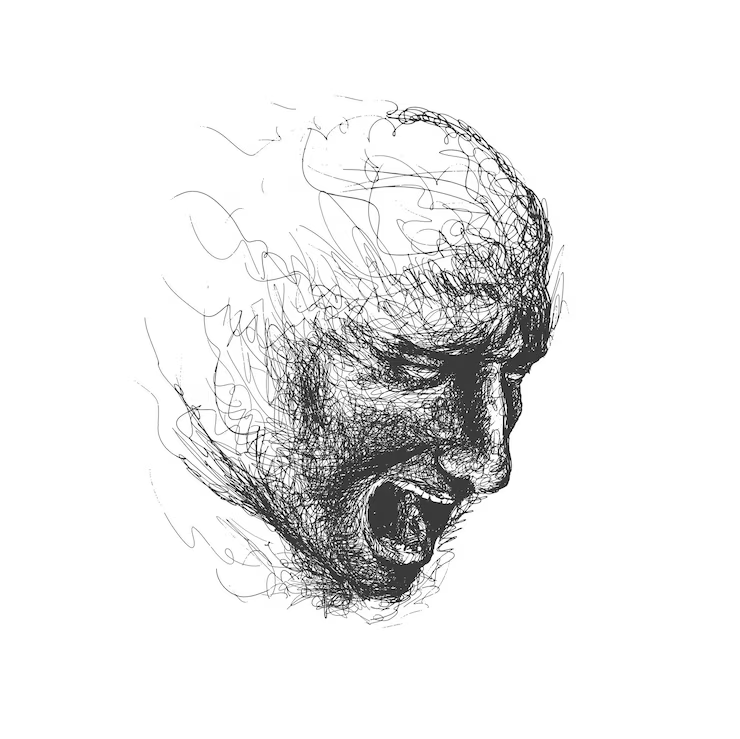
I’ve failed more times than I can count. In the gym. In the ring. At work. As a father, a partner, a man. And yeah—I’ve failed with MS, too. I’ve pushed too hard. I’ve ignored the signs. I’ve broken down, physically and mentally. I’ve hit rock bottom—more than once. But those failures made mo. They carved out the version of me that refuses to stay down. The one who trains while his legs tremble. The one who holds it together when his nervous system is screaming for help. The one who shows up—even when there’s nothing left in the tank. See, we’re raised to fear failure. To run from it. But I’ve learned something brutal and beautiful at the same time—If you never fail, you’re playing it too damn safe. And if you’re living with MS? Failure isn’t just likely—it’s part of the terrain. But here’s where I flip the script—I stopped fearing failure. I started learning from it. I started treating every setback as a sharpening stone. Every loss as a blueprint for how to come back stronger. This post isn’t about pretending to be bulletproof. It’s about showing you the scars—and why I wear them like armor. Because you don’t become resilient by winning. You become resilient by refusing to break when you lose. Let’s talk about that.
Failure Hurts… And That’s the Point.
No one wants to talk about it, but I will—Failure fucking hurts. It crushes your pride. Shakes your confidence. Makes you question if you’ve got what it takes. And when you’ve got MS on top of that—when your body already feels like it’s working against you—failure hits even harder. But here’s what separates the weak from the strong: Some people take failure personally. I take it seriously. I’ve missed lifts in the gym that I thought I could crush. I’ve had flare-ups that wiped out weeks of progress. I’ve had moments where my brain fog was so bad I couldn’t finish a sentence—let alone be the father or partner I want to be. And every single time, that pain lit something in me—Fire. Clarity. Drive. Because that sting? That humiliation? That frustration? That’s growth trying to happen. It’s the body, the mind, the soul saying You’ve hit your edge. Now what are you going to do about it? And yeah—it’s tempting to lie down, to disappear into self-pity. But I’ve been in the ring. I’ve been under the bar. I know what it feels like when the world’s bearing own and all you’ve got left is grit. And I know one thing for sure, i.e., pain is part of the process. You don’t build strength in comfort. You build it in the struggle. And failure—real, honest failure—is where you either start breaking down or start building up. That’s why I don’t hide from it anymore. I welcome it. Because if it’s hurting, it means I’m pushing past where I was yesterday. Keep in mind. Failure isn’t the enemy. Comfort is.
What Failure Taught Me About Limits. And Why That’s a Good Thing.
There’s a lot of tough guy talk out there about “no limits”. But here’s the hard truth I’ve had to learn the long way—especially with MS—You’ve got limits. We all do. And failure? It exposes them—brutally, honestly, without mercy. It shows you exactly where your body gives out. Where your minds starts spiraling. Where your discipline cracks under pressure. And in that moment, you’ve got two choices—pretend they’re not real or pay attention.
When I was younger—before MS, before the flare-ups, before the crushing fatigue—I thought I was invincible (and I still think in this way from time to time). I could push past pain, ignore warning signs, grind through anything. That mindset worked for a while…until it didn’t. MS Humbled the hell out of me. I remember one particular day—sparing with my friend, mid-week. I was amped. Ready to fight him. First couple of rounds went smooth, I was killing it. Then, out of nowhere, my brain gave out—neurological shutdown. I don’t remember much. I sat in the ring, furious. Embarrassed. Defeated. But after the anger cooled down, I realized something powerful—that was my edge. And now I knew exactly where it was. And when you know your edge, you stop wasting energy pretending it’s not there. You start working smarter. You recover better. Train more efficiently. You build systems around reality—not delusion. That’s what failure teaches you if you let it—awareness, precision, respect for the process.
With MS, your limits shift—daily, weekly, unpredictably. But that doesn’t mean you stop pushing. It just means you learn to measure differently. You learn to work with your body, not fight against it. You learn that discipline isn’t just about pushing hard—it’s about pulling back when you need to. And when you train with that kind of self-knowledge? You’re not weak—you’re lethal. Because the fighter who knows his limits is the one who can bend, recover, and still come back swinging.
Failure as a Brutal Teacher. But the Lessons Stick for Life.
Failure doesn’t whisper. It slaps you in the face. It doesn’t give you polite advice or gentle encouragement. It knocks the air out of your lungs and dares you to stand back up. And that’s why it works. See, the lessons I’ve learned from failure? They’ve stuck with me deeper than anything I ever got from a win. Success is great, but it’s a terrible teacher. It feeds your ego. Failure feeds your evolution. Let me break it down with some real-world scars:
- There was a time I tried to train through a flare-up. Stupid move. I ignored the signs—tremors, brain fog, brutal fatigue. I told myself I was just being “soft”. I ended up laid out for over a week. Couldn’t train, couldn’t work, couldn’t even think straight. But that wreckage taught me more than any perfect training session ever could. It taught me that toughness isn’t about ignoring pain—it’s about knowing when to pivot. It taught me that the rest isn’t weakness—it’s strategy. It taught me that being relentless doesn’t mean being reckless.
- Another time, I bombed a work deadline because I was juggling too much—pretending I could handle everything like I wasn’t living with a chronic illness. I let my pride drive. The crash that followed? It cost me trust, time, and a massive chunk of energy.
But now I’m sharper. I’ve got boundaries. I’ve got systems. I’ve learned to plan around energy, not just ambition. Every one of those failures forced me to level up. They made me reflect. Rebuild. Rethink. They stripped away my illusions—about my body, my mind, my expectations—and left me with something way more valuable—clarity. And look, those lessons didn’t come easy. They came through pain, disappointment, and frustration. But that’s how you grow when you’re in the fight every day—especially when your opponent is invisible, silent, unpredictable. MS doesn’t play fair. So I had to get smarter. Tougher. More honest. Failure didn’t ruin me. It refined me. It made me a better lifter. A better father. A better man. And most of all—it made me dangerous in the best way possible. Because now, I know exactly what I’m made of.
Building Mental Toughness Through Losses. The Fight That Happens in Your Head.
You don’t build mental toughness when things are going your way. You build it when your back’s against the wall and there’s no one coming to save you. Losses strip away your excuses. They reveal the raw, uncomfortable truth—are you mentally strong, or were you just riding momentum? Living with MS, I’ve had to stare down a lot of hard moments. Days where I couldn’t trust my legs. Nights where the fatigue felt like I was drowning in my own body. Times at the gym where I had to rack the weight early, not because I was tired—but because my nervous system was just done. Those were losses. No sugarcoating it. But they were also reps—mental reps. Every single one of those moments trained me to stay calm under pressure, to adapt, to keep my identity intact when my performance fell apart. Because that’s what true mental toughness is. It’s not never breaking. It’s refusing to stay broken.
There’s a part of you that gets forged when you suffer and refuse to quit. That part of you that whispers:
“Alright. That hurt. But I’m still here.”
That’s mental toughness. It’s the voice that shows up after a failed lift, a bad flare-up, a brutal day at work or with the kids—and says:
“You lost today. But you’re not done.”
And here’s the thing most people miss. Mental toughness isn’t built in the loud moments—not in the big speeches or the victorious lifts. It’s built in silence. In the quiet moments when no one’s watching and you still choose to do the hard thing. The hard choice to train anyway—even if it’s only 50%. The discipline to eat clean when all you want is comfort food. The grit to smile at your kid even when your body feels like it’s betraying you. You want to be mentally strong? Lose. Fall. Fail. And then stand back up like it never happened. Every loss I’ve taken? It didn’t weaken me. It thickened my skin. Sharpened my mindset. Tightened my circle. Because every time I fell and chose to get back up—I was building a version of myself that doesn’t need perfect conditions to keep swinging.
Losing Isn’t the End. It’s the Beginning.
Every loss you take is a test. Not of your body. Not of your diagnosis. But of your character. And if you’re reading this, if you’ve felt the sting of failure and kept going—you already know that this life with MS isn’t for the weak. It’s for the fighters. I’ve been knocked down by pain. I’ve been humbled by fatigue. I’ve lost battles that no one even saw happening. But I never stayed down. And that’s the difference. This blog, this mission, this message—it’s not about perfection. It’s about power. It’s about standing back up with grit in your teeth, chalk on your hands, and a look in your eyes that says:
“You picked the wrong guy to bet against.”
So here’s my challenge to you. Start seeing failure as a part of your training.
Every loss? A rep for your mindset.
Every setback? A new baseline for your comeback.
Every time you want to quit and don’t? That’s one more layer of armor added to your soul.Don’t fear failure. Don’t resent it. Fucking respect it. It’s your greatest coach. And now tell me—what’s the biggest lesson you’ve learned from failure? Drop it in the comments. Share your story.

 MS Fighter
Leave a comment